Kehinde Willeys Napoleon Leading the Army Over the Alps Is a Typical Example of Modern Art
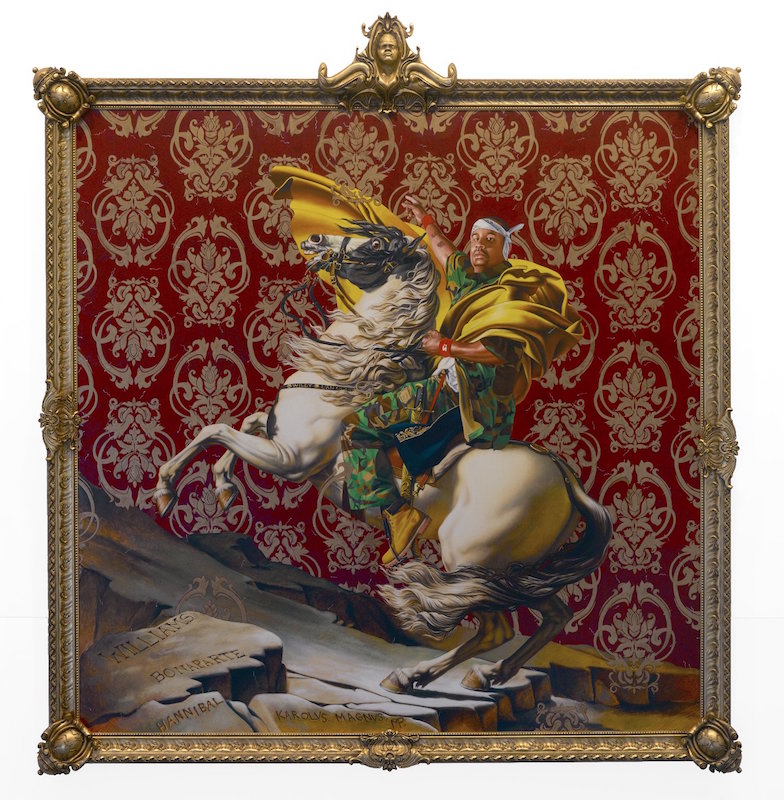
Kehinde Wiley, Napoleon Leading the Regular army over the Alps, 2005, oil pigment on sheet, 274.3 ten 274.3 cm (108 x 108 in) (Brooklyn Museum of Art, New York) © Kehinde Wiley
Against Art History
In this big painting, Kehinde Wiley, an African-American artist, strategically re-creates a French masterpiece from 2 hundred years before only with key differences. This act of appropriation reveals problems about the tradition of portraiture and all that it implies virtually power and privilege. Wiley asks us to think about the biases of the art historical canon (the set up of works that are regarded every bit "masterpieces"), representation in pop culture, and issues of race and gender. Here, Wiley replaces the original white field of study—the French general-turned-emperor Napoleon Bonaparte (beneath)—with an anonymous black homo whom Wiley approached on the street equally function of his "street-casting process." Although Wiley does occasionally create paintings on commission, he typically asks everyday people of colour to sit down for photographs, which he so transforms into paintings. Along the way, he talks with those sitters, gathering their thoughts almost what they should wear, how they might pose, and which historical paintings to reference.
Napoleon Leading the Army is a clear spin-off of Jacques-Louis David's painting of 1800-01 (below), which was commissioned by Charles 4, the King of Kingdom of spain, to commemorate Napoleon's victorious military entrada confronting the Austrians. The original portrait smacks of propaganda. Napoleon, in fact, did not pose for the original painting nor did he pb his troops over the mountains into Austria. He sent his soldiers ahead on pes and followed a few days subsequently, riding on a mule.
Choosing Symbolic Details
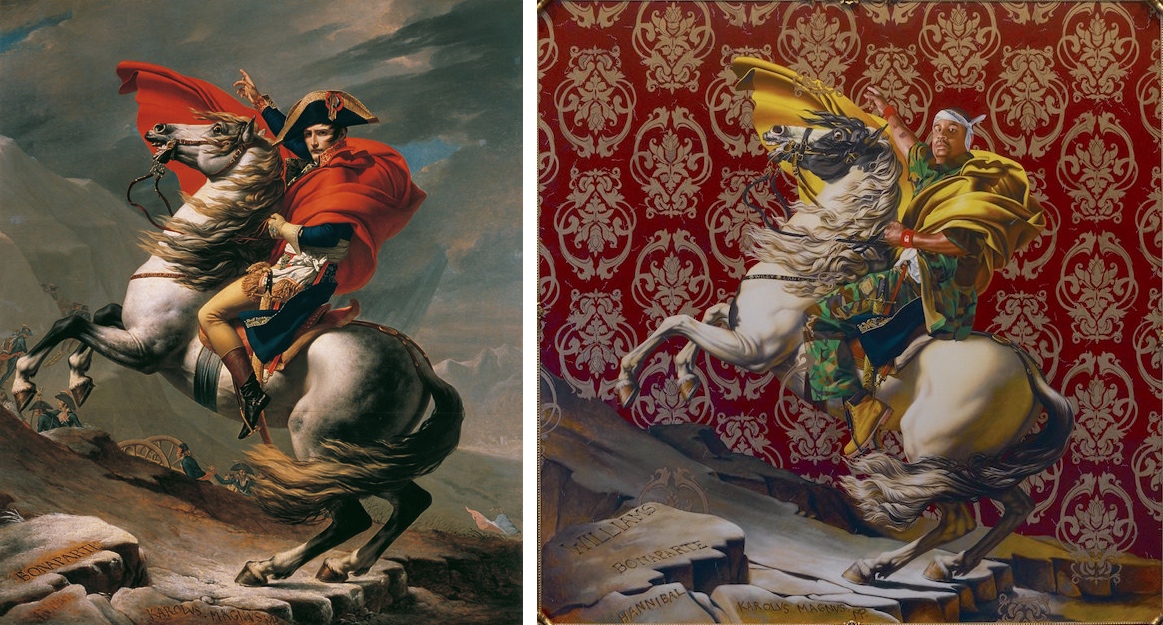
Left: Jacques-Louis David, Napoleon Crossing the Alps, 1803 version, oil on canvas 275 × 232 cm (Österreichische Galerie Belvedere); right: Kehinde Wiley, Napoleon Leading the Regular army over the Alps, 2005, oil pigment on sail, 274.3 x 274.3 cm (108 10 108 in) (Brooklyn Museum of Art, New York)
Wiley calls attention to ideas about authorisation and historical representation, keeping many original elements and making significant alterations. The majestic blue coat of the original makes an appearance (peeking out from the boyfriend'south cover-up shirt), as does the gold-encased sword (held in place by a red strap). But Wiley's subject wears an outfit that is completely contemporary and reflective of a culture notorious for flashy imagery and larger than life figures: hip hop culture. This swain wears cover-up fatigues, Timberland piece of work boots, and a bandana—conjuring up militaristic associations with the original painting and with the violence of contemporary urban America, particularly as experienced by immature black men. The discipline of Wiley's painting reveals his tattoos and wears red wristbands from the Starter sportswear company, details that add to the sense that this is a existent individual living in the early 21st century.
Instead of the naturalistic setting of David'due south painting, Wiley has inserted a decorative, unrealistic backdrop reminiscent of luxurious French fabric. This background, along with the high-keyed colors, and ornate frame (complete with faux family shields and the artist'southward self-portrait at the height) call attention to the artificiality and pompousness of image-making.
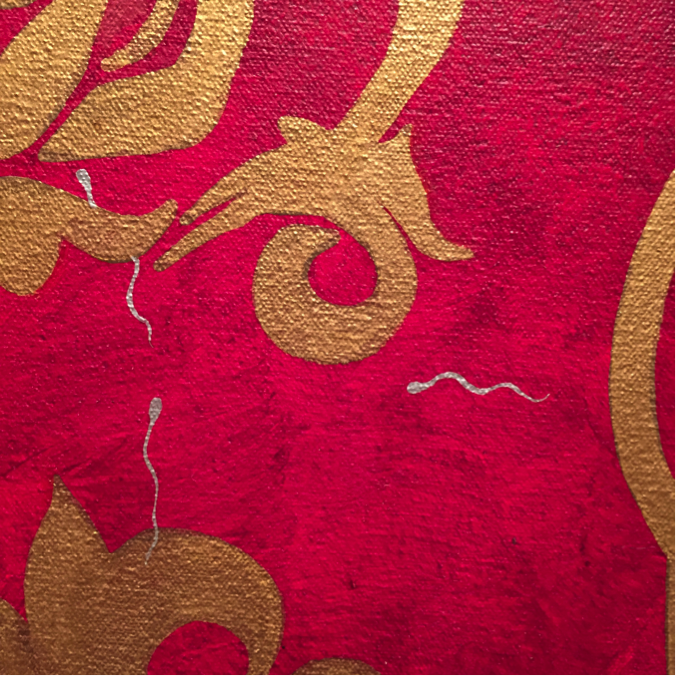
Sperm (item), Kehinde Wiley, Napoleon Leading the Army over the Alps, 2005, oil paint on canvas, 274.3 10 274.3 cm (108 ten 108 in) (Brooklyn Museum of Fine art, New York) (photograph: Gayle Clemans)
The groundwork is also infused with tiny paintings of sperm—Wiley's fashion of poking fun at the highly charged masculinity and propagation of gendered identity that are involved in the Western tradition of portraiture. This particular subgenre of portraiture—the equestrian portrait—is particularly infused with the lineage of male person power. From classical Rome to postal service-revolutionary France, political and military leaders on horseback take evoked and perpetuated social norms of masculine might and control (for example, this equestrian portrait of the Roman Emperor Marcus Aurelius).
Through his sit-in of extraordinary painting skill and his utilise of famous portraits, Wiley could exist seen every bit wryly placing himself in line with the history of slap-up chief painters. Here, for example, he has signed and dated the painting just equally David did, painting his proper name and the appointment in Roman numerals onto the band around the horse's breast. Wiley makes another reference to lineage in the foreground where he retains the original painting's rocky surface and the carved names of illustrious leaders who led troops over the Alps: NAPOLEON, HANNIBAL, and KAROLUS MAGNUS (Charlemagne). But Wiley also includes the proper noun WILLIAMS—another insistence on including ordinary people of color who are oft left out of systems of representation and glorification. Not only is Williams a common African-American surname, it hints at the imposition of Anglo names on black people who were brought past force from Africa and stripped of their own histories.
About the Artist
Kehinde Wiley (American, born 1977) attracted media and art world attention almost immediately later on earning his MFA from Yale Academy in 2001. He was an artist-in-residence at the Studio Museum in Harlem and has been included in many meaning group and solo exhibitions. Wiley now employs studio assistants who participate in his "street-casting" process and in the various stages of painting and sculpture fabrication. In addition to big-scale paintings, Wiley has created stained glass, painted altarpieces, and cast bronze sculptures, all of which examine of art history, race, gender, and the power of representation.
Boosted Resources:
Gayle Clemans, "The Stunning and Destructive Pageantry of Artist Kehinde Wiley," The Seattle Times, Feb 16, 2016.
Shahrazad A. Shareef, "The Power of Decor: Kehinde Wiley's Interventions into the Construction of Black Masculine Identity" (UMI Dissertations Publishing, 2010).
Roberta Smith, "Kehinde Wiley: A New Commonwealth at the Brooklyn Museum," New York Times, February 19, 2015.
Eugenie Tsai, ed., Kehinde Wiley: A New Republic (Brooklyn, New York: Brooklyn Museum, 2015).
Source: https://smarthistory.org/kehinde-wiley-napoleon-leading-the-army-over-the-alps/
0 Response to "Kehinde Willeys Napoleon Leading the Army Over the Alps Is a Typical Example of Modern Art"
Post a Comment